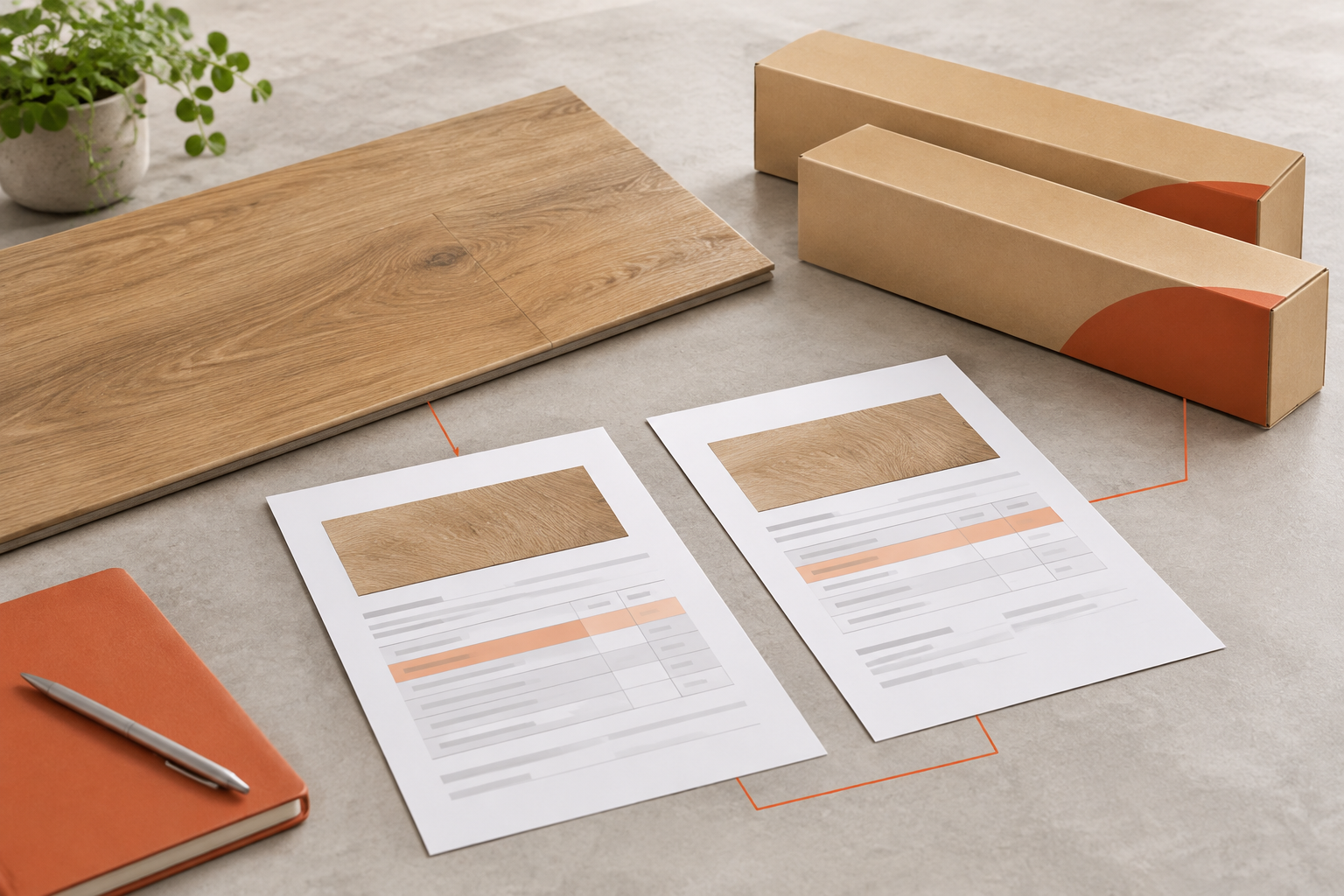
Flooring Carton Labels: Trace Mixed-SKU Shipments
Build an identification plan that connects supplier references, private-label SKUs, cartons, pallets and packing lists, with practical checks for mixed-reference receiving and discrepancy records.
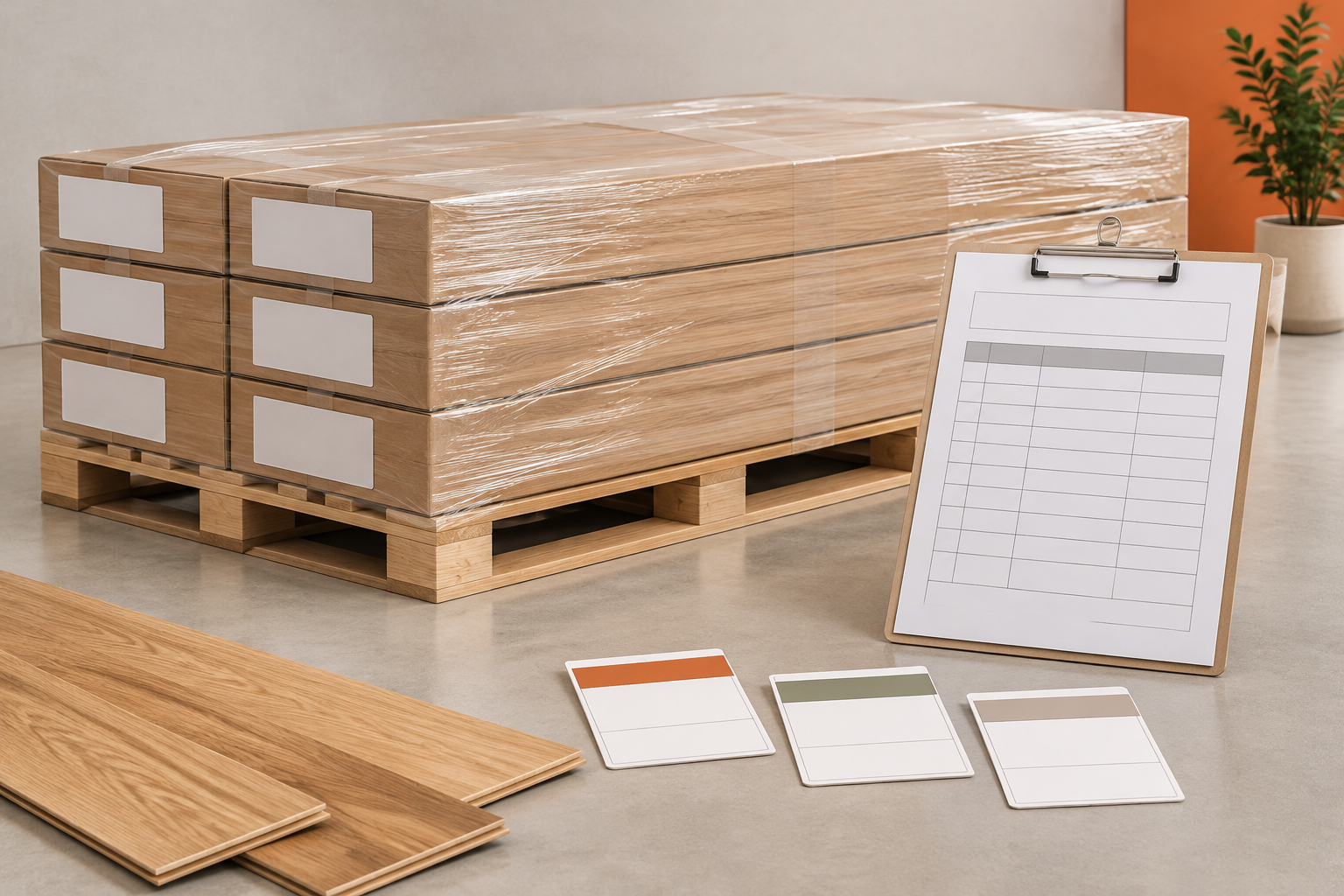
Table of Contents
- What should flooring carton labels help a receiving team verify?
- Distinguish buyer SKUs, GL product references and brochure colour codes
- Which identification fields belong at each packing level?
- Comparison table: carton, pallet and packing-list identification
- Keep product identity separate from destination-specific label requirements
- How should private-label and manufacturer references be mapped?
- How can mixed-reference receiving be planned before dispatch?
- A numbered process for checking artwork, mapping and packing records
- What records are useful when labels or quantities do not match?
- How can GoLink product references be used in a label brief?
- Frequently asked questions
- Next step: submit a product-mapping and label-field brief
Flooring carton labels should let receiving teams match each carton to the accepted product specification and order record, even when a shipment contains several references. For distributors, importers and private-label buyers, agree how the buyer’s SKU—a stock-keeping identifier—connects to supplier references, quantities and pallet records; the suggested fields below require order-specific agreement.
What should flooring carton labels help a receiving team verify?
A receiving team should be able to identify the ordered product, connect it to the correct order line and reconcile its quantity without relying on carton colour or a marketing name. This is general procurement guidance, not a statement of GoLink Floor’s standard label format.
For a mixed-SKU flooring shipment, ask whether staff can distinguish similar-looking cartons after the pallet wrap is removed. A label should remain useful when a carton moves into storage or is picked individually. Agree which order, production-lot or other traceability reference will connect it back to retained records.
Label verification confirms recorded identity. It does not replace checking the supplied flooring against the accepted specification and representative samples.
Distinguish buyer SKUs, GL product references and brochure colour codes
- Buyer SKU
- The buyer’s stock-keeping identifier for a defined inventory item.
- Supplier product reference
- The manufacturer’s reference used to identify a product within its records or published range.
- Brochure colour code
- An appearance reference that needs an explicitly confirmed connection to the ordered product.
A buyer SKU does not need to be identical to the manufacturer’s reference. The connection must be unambiguous in an agreed mapping record. GoLink’s four-digit GL references and five-digit brochure colour identifiers are separate sets; matching digits or similar colour names do not establish equivalence.
Which identification fields belong at each packing level?
Give each packing level a clear role: cartons identify their contents, pallets identify handling groups, and the packing list reconciles the shipment. Every carton does not necessarily need a unique serial number; agree whether product-level identification and a shared lot reference meet the receiving requirement.
State quantity units explicitly. Carton count, board count and flooring area are different measures. If dimensions appear, use millimetres (mm) and distinguish total board thickness from hardwood face thickness. If area appears, identify square metres (m²) and the agreed quantity basis. Use only values confirmed for the actual packing configuration.
Comparison table: carton, pallet and packing-list identification

The following fields are a discussion template, subject to manufacturing, warehouse and order review.
| Packing level | Suggested identification | Receiving check |
|---|---|---|
| Carton | Buyer SKU; agreed supplier reference or mapping key; product description; quantity and unit; order or lot reference as agreed | Does this carton match the intended inventory item and order line? |
| Pallet | Pallet identifier; shipment reference; contained SKUs and carton counts, directly or through an accompanying record | Can staff identify every reference within this handling group? |
| Packing list | Order lines; mapped product references; pallet identifiers; carton counts; agreed area or other quantities and units | Do pallet contents reconcile by SKU and across the shipment? |
For mixed pallets, a single product name on the outer wrap is insufficient. Agree how the pallet identifier connects to a contents record that remains accessible during unloading.
Keep product identity separate from destination-specific label requirements
The buyer or importer should coordinate destination language and marking requirements with appropriately qualified advisers, while the manufacturer confirms the agreed marking scope. Assign responsibility explicitly before approving artwork.
Product identity alone does not establish compliance. Country-of-origin wording, importer details, required declarations and any authorized certification marks need separate review for the actual destination and product. Do not add marks merely because they appear in a brochure.
Use GoLink’s packing and shipping information to frame discussions about labels, documents, route and shipping responsibilities. Confirm those responsibilities in the accepted order.
How should private-label and manufacturer references be mapped?

Keep one agreed mapping record linking each buyer SKU to its supplier reference, accepted specification and sample reference. Private-label product mapping should identify the complete ordered configuration, rather than only its sales name.
Include the specification revision and relevant construction, dimensions, grade, texture, colour treatment, coating and joint. Where one supplier style is developed into different configurations, distinguish the inventory items rather than treating the style code as a complete specification.
The carton may show a buyer-facing identifier while supporting records retain the manufacturer’s reference. Agree who can access that connection. GoLink’s OEM and private-label support provides context for connecting product identity, samples, carton artwork and order records.
How can mixed-reference receiving be planned before dispatch?
Start with the receiving warehouse’s workflow. Confirm whether staff receive by order line, scan a buyer SKU or reconcile pallet contents manually. Then agree whether pallets will contain a single reference or multiple references and how exceptions will be shown.
Flooring pallet identification must remain usable through wrapping, unloading and separation into stock. Agree label positions and request representative packed-label images for review. If scanning is required, define the barcode format, encoded data and human-readable fallback. Barcode labels are not automatically included in a private-label order; scope, feasibility and any charges require confirmation.
A numbered process for checking artwork, mapping and packing records

- Confirm identity: reconcile buyer SKUs, supplier references, specification revisions and sample references against accepted order lines.
- Approve field content: check spelling, units, quantity basis, destination wording and responsibility for each supplied value.
- Review a populated proof: check realistic field lengths and similar identifiers; blank artwork cannot reveal incorrect product data.
- Check warehouse usability: review label position and readability on packed cartons and wrapped pallets; trial any agreed barcode with the receiving system.
- Reconcile dispatch records: compare actual carton counts by reference and pallet with the final packing list, including partial or exception packs.
- Prepare receipt: send the agreed records to the receiving team and nominate a contact for discrepancies.
This flooring receiving checklist should also define who approves corrections. Retain the accepted versions so procurement, packing and warehouse teams use the same information.
What records are useful when labels or quantities do not match?
Preserve the connection between the physical carton and the receiving record. Photograph the carton label, pallet identifier, wrapping condition and affected contents where appropriate. Record the receipt date, order reference, expected quantity, counted quantity and units.
Separate uncertain stock from released inventory while the discrepancy is reviewed. Avoid overwriting labels or combining unidentified cartons with confirmed stock. Distinguish a missing carton, an incorrect SKU label and an area discrepancy: each requires a different reconciliation.
Keep the packing list, mapping record, approved artwork and relevant correspondence together. GoLink’s after-sales record preparation explains the value of order identity, photographs and a clear timeline when raising a concern.
How can GoLink product references be used in a label brief?
Use GL-0225 Pale Wheat Oak as an example supplier reference. Its published description identifies a light oak engineered plank direction with brushed texture and UV lacquer. A buyer could connect that reference to its own SKU in the agreed mapping record.
The reference does not establish carton coverage, board dimensions, hardwood face thickness, joint or certification. Confirm those details through the accepted specification and packing record. If a brochure colour is also involved, record its separate identifier only after the relationship is confirmed. This example illustrates mapping; it does not promise a supplied label layout or barcode service.
Frequently asked questions
These receiving details should be resolved alongside the product-mapping and label-field brief.
Next step: submit a product-mapping and label-field brief
A useful brief connects each buyer SKU to an accepted product configuration, assigns identification fields to cartons and pallets, and defines reconciliation against the packing list. Agree this structure before label approval so the receiving team can follow the same product identity from unloading into stock.
FAQ
Should every flooring carton have a unique serial number?
Only if the agreed warehouse or traceability process requires individual-carton tracking. A product identifier and lot reference serve different purposes from a unique serial number. Define the required level before confirming label scope.
Can a pallet label replace carton identification?
A pallet label alone leaves an identification gap when cartons are separated. Agree enough carton-level information to connect loose cartons to the product and retained records, even when detailed shipment information stays on the pallet record.
How should partial cartons or exception packs be identified?
Agree an exception label showing the actual contents and quantity basis. Ensure the packing list reflects that exception; applying a full-carton quantity to a partial pack can distort receiving totals.
What if a barcode scans successfully but opens the wrong product?
Successful scanning proves readability, not correct mapping. Compare the decoded value and warehouse item record with the approved SKU mapping. Hold affected inventory pending clarification and retain the label and scan result as evidence.
Discuss Your Engineered Flooring Requirements
Share your species or GoLink product reference, plank or pattern format, estimated quantity per colour and destination. Add your buyer SKU mapping, proposed label fields and any barcode, branding or document requirements so GoLink Floor can review the specification and quotation brief. Label scope and commercial terms require order-specific confirmation.